Nvidia’s planned backstop for OpenAI’s huge Ohio data-center project has moved from negotiation to a signed structure, but at less than half the exposure first discussed.
Nvidia will provide up to $105 billion of guarantees tied to the PORTS-Pike Technology Campus in Pike County, Ohio, Reuters reported Monday, while investing another $1.5 billion in developer SB Energy. That is below the “less than $120 billion” figure reported Friday and far below the roughly $250 billion guarantee that had been under discussion in July.
The timing matters. Friday’s Wall Street Journal report said a deal could be signed as early as the August 15–16 weekend. The formal announcement came Monday, August 17, confirming that the project is proceeding but with Nvidia’s risk ring-fenced more tightly than the original proposal.
What Changed, and the Two Numbers
The headline comparison is $250 billion versus $105 billion.
In July, Nvidia was discussing a roughly $250 billion backstop to help OpenAI lease the Ohio campus. By Friday, the Journal reported that Nvidia expected to guarantee less than $120 billion after investors raised concerns about the chipmaker’s exposure. Monday’s completed arrangement capped the guarantee at $105 billion, according to Reuters.
Nvidia’s own announcement does not put a dollar figure on the guarantee. It says the company will provide credit support for land, power and shell construction associated with the initial 4.25 IT-gigawatts of capacity. OpenAI will ultimately be the customer for 8 IT-GW under a 20-year lease from SB Energy.
That makes the reduction more than a headline haircut. It changes which stages of a multiyear build Nvidia is initially putting its balance sheet behind.
“First Phase Only” — What That Actually Limits
The first phase covers 4.25 IT-GW. The remaining 3.75 IT-GW is not part of Nvidia’s initial credit support.
Nvidia also said the guarantee is not a blanket promise to cover the entire project or all of OpenAI’s obligations. Reuters reported that it covers part of lease and power payments and includes a commitment around the site’s minimum residual value. The guarantee would apply if OpenAI defaults or becomes insolvent, with SB Energy first required to try to relet the capacity at the same rate and then sell the project. Nvidia would cover the remaining shortfall, while OpenAI would reimburse Nvidia for payments made under the guarantee. The guarantee would also terminate if OpenAI reaches investment-grade status. The first 800 megawatts are expected to become available in 2028, with the wider campus built out in phases.
Limiting the guarantee this way matters because the project’s economics stretch over decades while AI hardware turns over far faster.
Why Investors Pushed Back on the Exposure
The retreat followed investor concern about how much risk Nvidia was assuming to support infrastructure that will ultimately consume Nvidia hardware.
That concern had already surfaced when Nvidia was discussing the $250 billion version. Nvidia shares fell nearly 5% after the original talks were reported, the Journal said. Seaport Research analyst Jay Goldberg also warned that the structure revived memories of vendor-financing practices from the late-1990s telecom boom, when suppliers helped customers finance purchases that ultimately benefited the suppliers themselves.
FinanceFeeds reported on August 11 that Nvidia had separately partnered with Apollo, BlackRock, Blackstone, Brookfield, Goldman Sachs and KKR on platforms intended to mobilize more than $500 billion of third-party capital for AI infrastructure. Those structures were presented partly as a way to shift more of the financing burden to outside capital.
The Circular-Financing Question in Plain Terms
The circularity issue is straightforward: Nvidia sells the chips, the data center is being built to host those chips, OpenAI is the customer using the capacity, and Nvidia is helping make the financing possible.
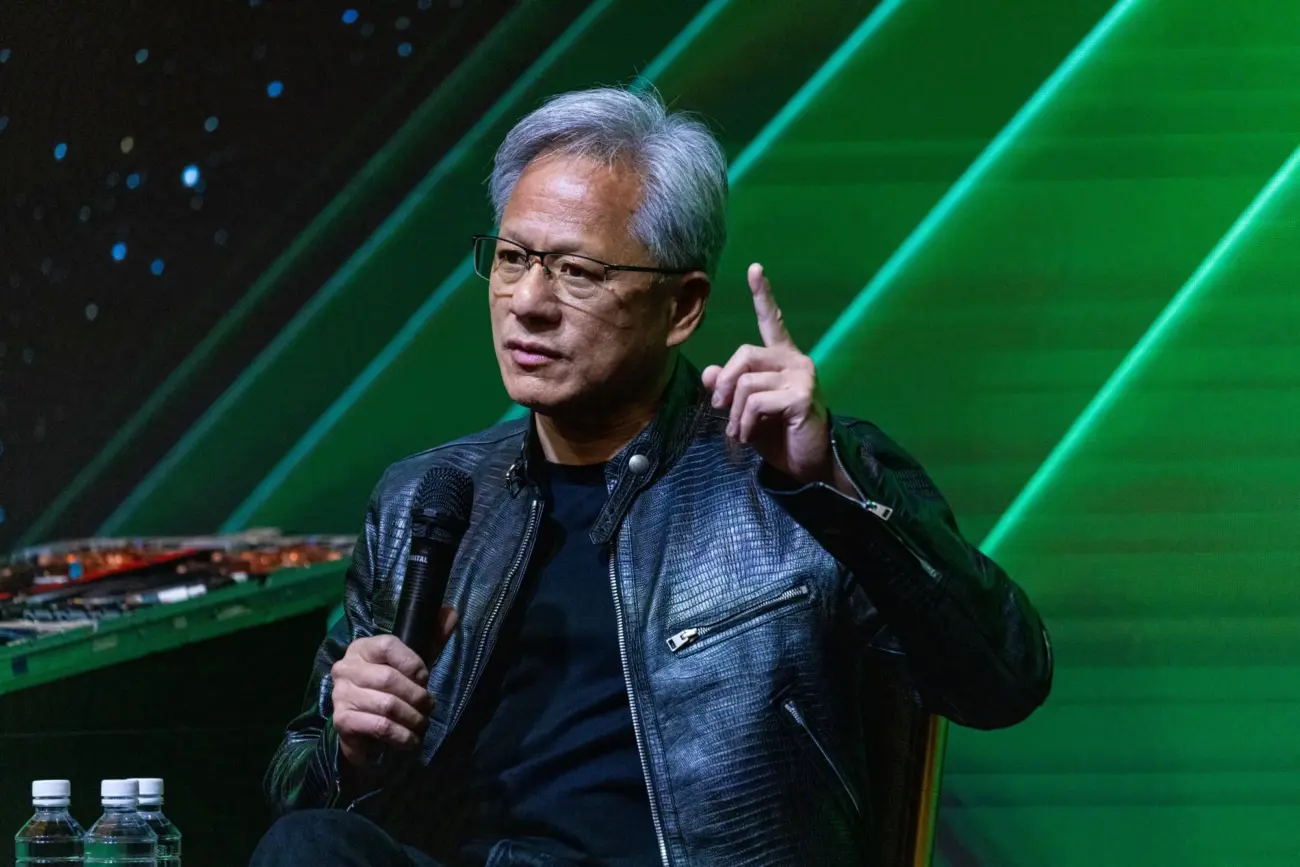
That does not mean the transaction is economically circular in the strict sense. Nvidia CEO Jensen Huang rejected that characterization Monday and said the company is using its scale and long-term visibility to secure infrastructure for Nvidia compute.
But the investor question is whether demand still represents an independent customer decision when the vendor is also supporting the financing behind that demand.
The $105 billion cap reduces that exposure without removing it. Nvidia will be the exclusive AI compute infrastructure provider at PORTS-Pike and is also investing $1.5 billion directly in SB Energy. The commercial upside therefore remains substantial if OpenAI’s compute demand develops as expected.
What Is Signed, and What Remains Optional
The uncertainty flagged Friday is no longer whether a deal will be signed. Nvidia, OpenAI and SB Energy announced the project Monday.
What remains conditional is the second half of the buildout. Nvidia has committed credit support to the initial 4.25 IT-GW, while the remaining 3.75 IT-GW is outside the initial commitment. OpenAI says further development depends on infrastructure, permits, environmental reviews and financing.
That distinction is the clearest answer to the market’s pushback. Nvidia has not walked away from financing AI demand. It has reduced the amount of its own balance sheet that must stand behind the first commitment, while keeping the right to expand if the economics justify it.